Case Study
Window Cleaning Website Design — London Window Clean Case Study
A Central London window cleaner with thirty years on the glass and no website at all, built from one phone call into sixteen pages: a building you pick a floor on, a window you wipe with a squeegee, and a map of London that answers whether he covers your borough.

A new business, one phone call, and no website
Dean Stevens has been cleaning windows for thirty years. Stevens & Son Complete Property Solutions is his company: five of them, covering the City, the West End and Central London, round the clock, with £5 million of public liability cover. What he did not have was a website, a domain or a single page of copy.
So the site was built from a phone call. The call was transcribed, and every fact on the sixteen pages — the services, the heights he can reach, the areas, the insurance, the years — is a thing he said. Nothing was borrowed from a competitor’s site and nothing was invented: no prices, because he has never given one, and no accreditation he does not hold.
His own photographs carry the pages where he had them; where he had none, licensed stock stands in, and it is recorded as such in the build so it can be swapped the day his own arrive.
Two designs, and the one he chose
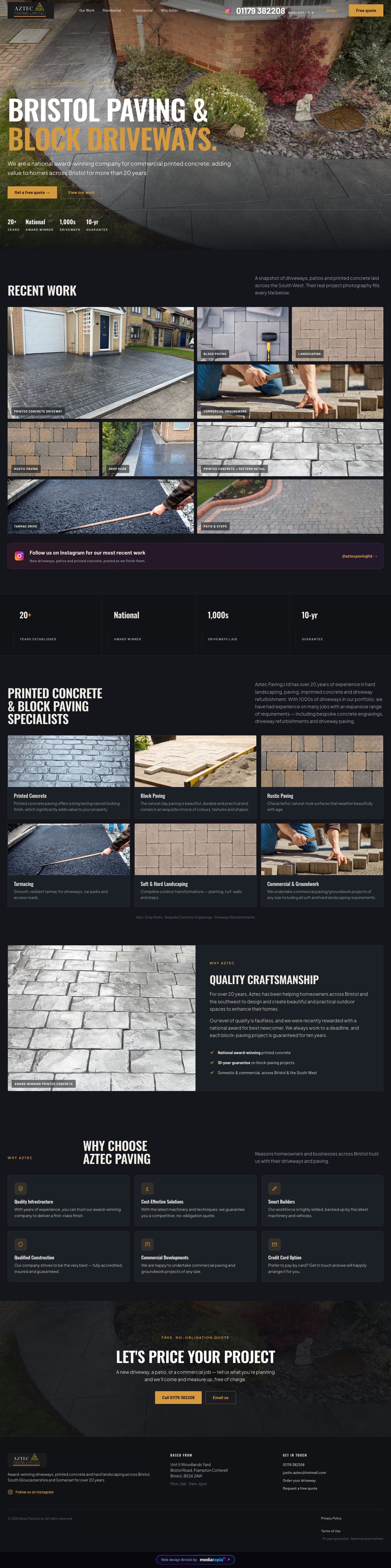
Two whole websites were built and sent to him, numbered: a lighter, cleaner design and a dark, photographic one. He replied that he liked them both but wanted the first.
Both had been built on the same sixteen addresses, so the one he chose went to the root page for page with no address changing and no redirect needed. The dark design is kept in the build folder, unpublished, rather than thrown away.
That is how a new site is agreed here: not a mock-up to imagine from, but the real thing at a real address, on his phone, before anything is pointed at his domain.
A building you pick a floor on
The one thing a building manager needs to know from a window cleaner is how high he can go and with what, and Dean’s methods genuinely differ by height: traditional cleaning at ground level, a gutter vacuum up to five floors, reach and wash with purified water up to six floors from the ground, and ropes or a cherry picker above that.
So the home page opens on a building. Pick a floor and that band lights, the pole or the rope appears against it, and the method is named with his own line about it. It is built with CSS radios, so it works with scripts blocked and on the oldest phone in the building.
Under it, a window you wipe: one of his photographs in two layers, the top one the same picture under a grime filter, clipped by a slider. Drag the squeegee across and the clean glass shows through. It sweeps itself once when it first comes into view, and then it is yours.
A map of London that answers one question
The areas page is a real map of London, not a list. Sixteen inner boroughs are drawn from the open borough boundaries, simplified and projected in the build, shaded where he cleans and grey where he does not.
Point at a borough and the panel beside the map says We clean in Camden, with that area’s own paragraph and its three points, or We do not usually cover Brent with the three areas he does. On a phone, below the burger breakpoint, three plain tabs pick an area with no script at all.
Two faults the map had were about height, and both were found by looking: the answer panel took the map out from under the cursor when it swapped in, and a short answer left a slab of white under it. The answer and the picker now share one grid cell and carry the same substance, so the page is the same height in every state.
Headings that say what he does
The first draft was clever and useless: “Thirty years on the glass”, “One firm for the whole building”, “Five million in cover”. A heading like that is not what anyone types into Google. They became “Window cleaners with 30 years’ experience”, “Our window cleaning and property maintenance services” and “£5 million public liability insurance” — his facts, in the words a search uses.
Each service has its own page: window cleaning, reach and wash, abseiling, cherry picker work, gutter clearance, painting and decorating, property maintenance and the rest, each with his own points for it. The home page carries business schema, the service pages carry service and FAQ schema, and the areas page an item list, so Google and the AI assistants can read what he does and where without guessing.
His registered office is his home, and it appears nowhere on the site or in the schema. He said no, and that is the end of it.
Tested at the school gate, and live in the same week
On the morning of go-live the phone menu was rebuilt to the standard every site here uses, because the check found it: opened, the panel measured 1,006 pixels on an 844-pixel iPhone, and Central London, About, Contact and the call button could not be reached at all. The menu now fits the screen, scrolls inside itself, hides the page behind it and steps the chat dock aside, and every row is 62 pixels — a thumb’s worth.
Every one of the sixteen pages was then checked on the live address: a unique title and description, one main heading, every internal link landing, no text failing the contrast standard, the keyboard reaching every control, nothing overflowing at 320 pixels, and a labelled test enquiry arriving in his inbox and the CRM.
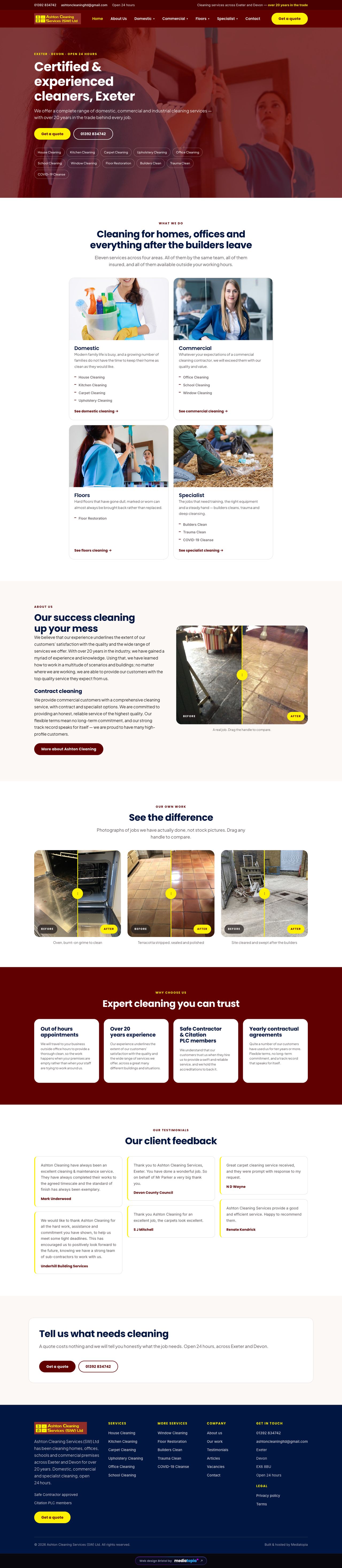
londonwindowclean.co.uk went live on 8 October 2026 on a brand-new domain, with his own email address at it forwarding to his inbox. It is a managed service: he rings, we change it. If you run a cleaning company or a property maintenance firm, that is exactly the work. The Ashton Cleaning case study is the comparable project.
What We Built
Project development work carried out
A Building You Pick A Floor On
His four access methods by height — traditional, gutter vac to five floors, reach and wash to six, ropes or a cherry picker above — as a building in the hero that lights the floor you choose.
A Window You Wipe
One of his photographs in two layers, the top one under a grime filter, clipped by a slider you drag like a squeegee.
A Map Of London That Answers
Sixteen inner boroughs drawn from open boundary data, shaded where he cleans; point at one and the page says whether he covers it, in his own words.
Sixteen Pages From One Phone Call
Every fact transcribed from the call and nothing invented: his services, heights, areas, insurance and years, with the headings written the way people search.
Common Questions
Window Cleaning Website Design FAQs





Need a website for your cleaning company?
Tell me what you need and I will give you a fixed price. You deal with the person who builds it — not an account manager, not an offshore team.